Most of what's exciting about agentic AI rests on a quiet assumption: that the agent can afford to be wrong.
Let it plan. Let it act. If it picks the wrong tool, it notices and tries again. If it writes a bad query, it rewrites it. That loop (try, observe, correct) is the whole reason agents feel powerful instead of brittle. Mistakes aren't failures. They're just steps on the way to the answer.
Now drop that same agent into a bank, a hospital, or a drug-safety team. The assumption falls apart.
The world most agents are built for
Pick up almost any agent framework and you'll feel the optimism baked into it. The agent can call APIs, write files, query databases, fire off messages. Something breaks? Retry. Wrong answer? Self-correct. The design treats the environment as a sandbox you can poke at until it gives way.
For a coding assistant or a research agent, that's exactly right. The cost of a wrong move is a few wasted seconds and a second attempt. Exploration is cheap, so you let the agent explore.
Regulated work doesn't run on cheap mistakes. In financial services, healthcare, pharma, insurance, energy, a wrong action isn't an inefficiency you shrug off. It can be a reportable incident. A filing that's now wrong. A control you just failed. The retry isn't free; sometimes there's nothing left to retry.
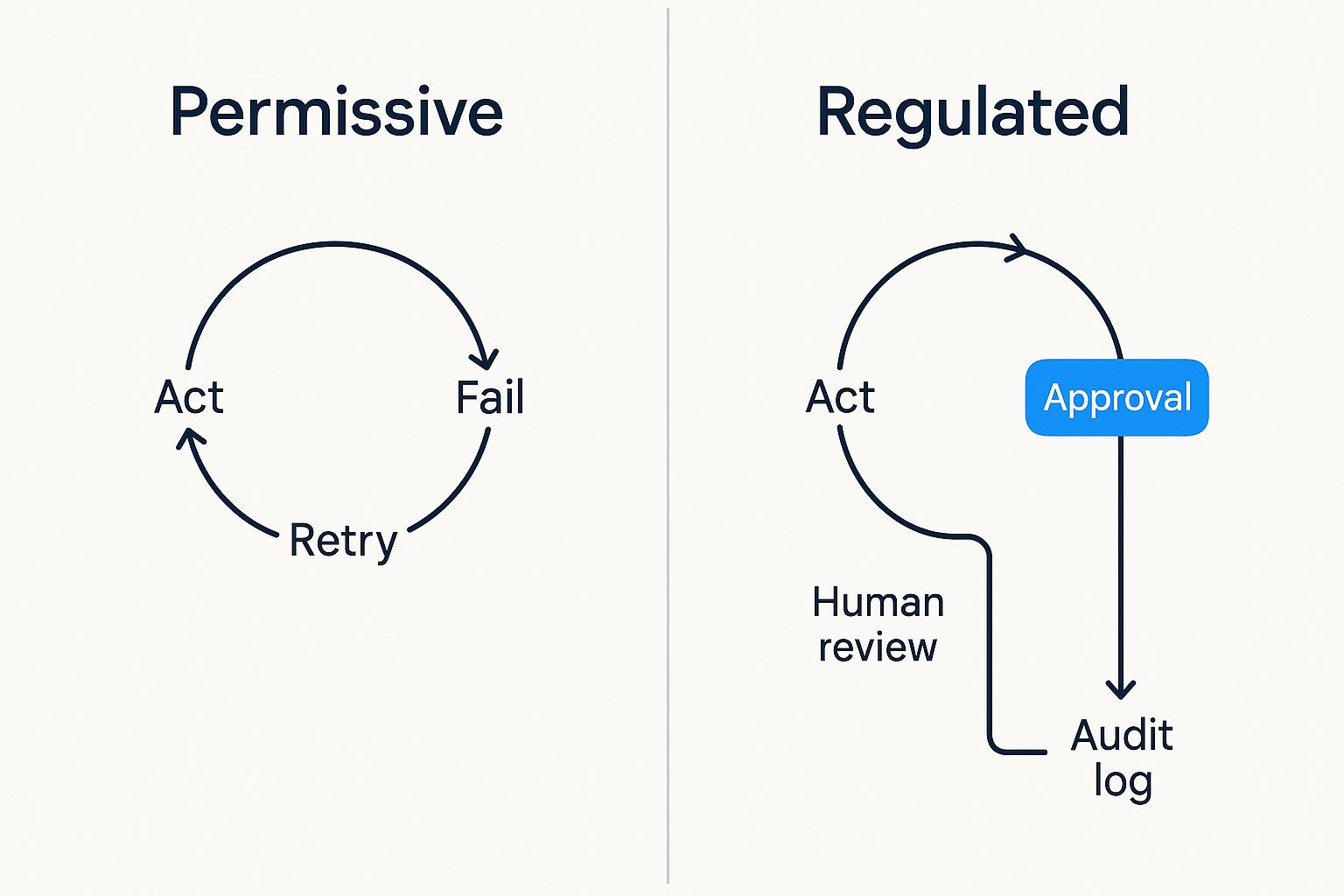
That picture on the right is the whole job. Same agent, same goal, but every consequential action now passes through a gate before it touches the real world.
What actually changes when you're regulated
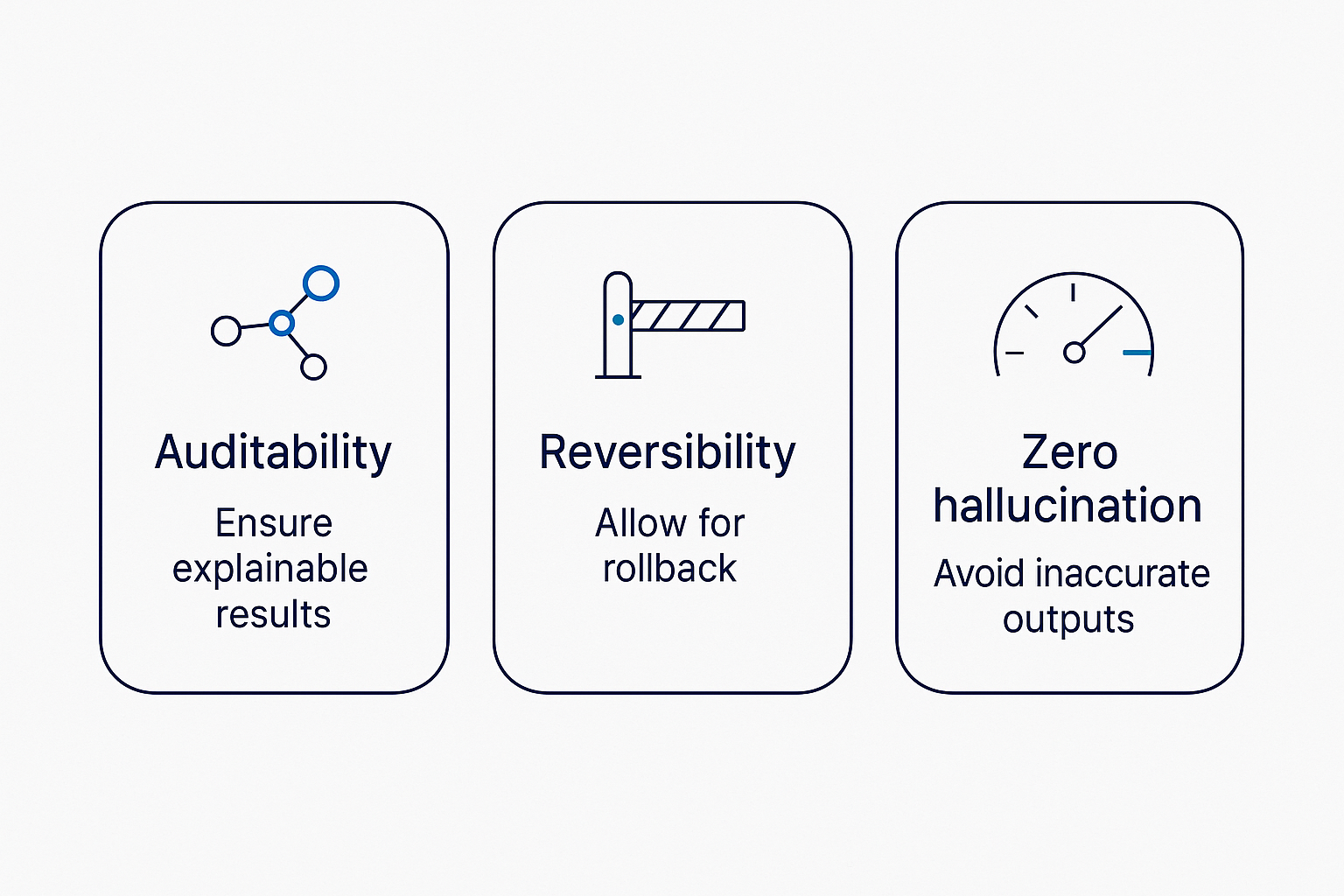
Three things, and none of them are optional.
Auditability isn't a log. It's the product. In a consumer app, logs are for the engineers. In regulated work, the trail is the deliverable. When someone asks why the agent flagged this transaction, cleared that claim, or escalated this case, "the model decided" is not an answer. You need the actual chain: what it saw, what it weighed, what rule it applied, in what order. Not just inputs and outputs. The reasoning in between, captured at the moment it happened, in a form you can hand to an examiner and defend.
Some actions can't be taken back. Submitting a regulatory filing. Releasing a payment. Amending a patient record. These aren't database writes you can quietly roll back. Once they're out, they're out. So either the agent doesn't take them autonomously at all, or it takes them only inside hard limits set in advance: pre-approved amounts, pre-authorized recipients, pre-cleared templates, with a human on the hook for anything outside the lines.
Hallucination tolerance is zero. A consumer agent can invent a citation and the user shrugs and corrects it. A regulated agent that invents a compliance status, a drug interaction, or a portfolio exposure has produced a liability with a confident tone. The bar isn't "usually right." It's "never wrong in a way that ships unchecked." That changes how you handle uncertainty, not as a number in a log, but as a trigger that stops the line.
Designing for it instead of bolting it on
Here's the trap I see teams fall into. They build the agent the permissive way, get a great demo, then try to wrap compliance around the outside like a fence. It never holds. Auditability you add at the end is a reconstruction, not a record. Guardrails you add at the end are the things the agent learned to route around.
The constraints have to be load-bearing from the first line. In practice that means a few unglamorous commitments.
Narrow the action space on purpose. An agent that can do anything is an agent you have to prove won't do the wrong thing. An agent that can only take a short list of pre-defined, individually-vetted actions is one you can actually reason about. Determinism beats cleverness here.
Make confidence do real work. Below a threshold, the agent doesn't guess; it routes to a person. That's not the agent failing. That's the agent doing exactly what a regulated process should: knowing the edge of what it knows.
Log the reasoning as it runs, in a schema, not a stack trace. If you can't replay the decision later, you don't have an auditable system. You have a fast one.
So is it worth it?
Yes, and I want to be clear about that, because everything above can read like a list of reasons not to bother.
The opportunity in regulated automation is enormous precisely because it's hard. The work is high-volume, rules-heavy, and expensive to staff with people. That's the work agents are built to absorb. The risk isn't a reason to stay out. It's a reason to design properly.
The teams that win here won't be the ones with the cleverest agent. They'll be the ones who treated auditability, reversibility, and uncertainty as the architecture, not the paperwork. In regulated AI, being able to stand behind what your agent just did isn't a feature you add later. It's the entire point.