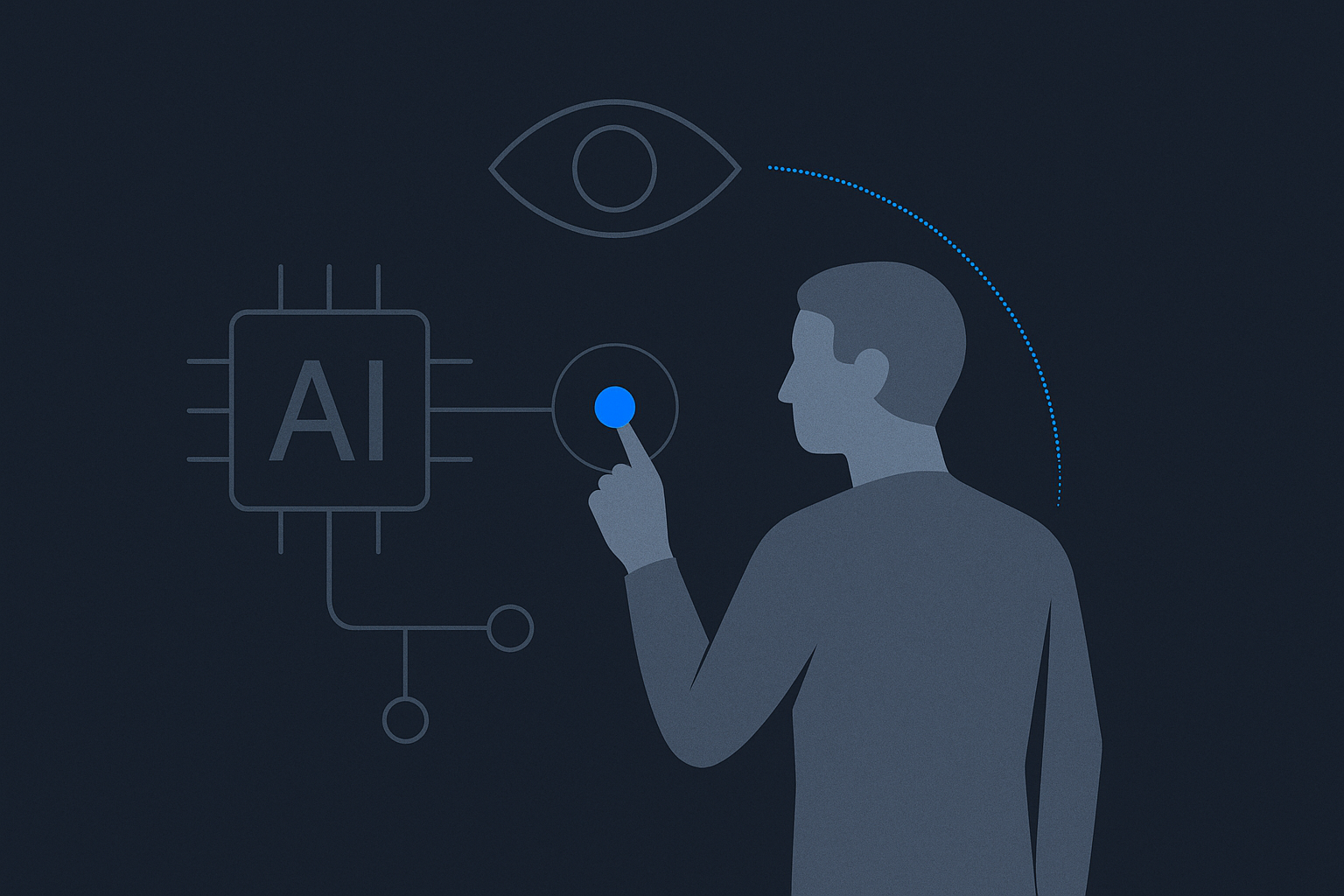
When regulators worry about an AI system, the reassurance they reach for most often is human oversight: "there is a person reviewing these decisions". And when AI governance fails in practice, hollow human oversight is one of the most common culprits — a human nominally "in the loop" who, in reality, rubber-stamps whatever the machine proposes. This part is about the difference between the two: how to design human involvement that genuinely catches errors and exercises judgement, rather than oversight that exists only to be pointed at.
Why human oversight, and why it disappoints
Human oversight serves real purposes. A human can catch errors the model misses, apply context and judgement the model lacks, take responsibility the model cannot, and provide the "human intervention" that privacy and sectoral law often require for significant automated decisions. These are genuine benefits — when the oversight is real.
The trouble is that human oversight is uniquely prone to becoming a fiction while still appearing on the org chart. The reasons are well understood and worth naming, because each is a design problem you can address:
- Automation bias. People over-trust machine outputs. Faced with a confident model recommendation, a human reviewer tends to defer, especially when the model is usually right. The reviewer becomes a conduit for the model's decisions rather than a check on them.
- Volume and time pressure. A reviewer asked to "approve" hundreds of decisions an hour cannot meaningfully consider each. Throughput targets quietly convert review into rubber-stamping.
- Lack of information. A reviewer who cannot see why the model decided as it did has nothing to review. Without explanation, oversight is blind.
- Lack of authority or incentive. A reviewer who is discouraged from overriding — by culture, metrics, or consequences — will not, no matter what the policy says.
Putting a human in the loop is easy. Putting a human in the loop who actually sees, understands, and can change the decision is the entire challenge.
Levels of human involvement
"Human oversight" spans a spectrum, and choosing the right level for a given decision is a core design choice driven by the system's risk tier.
Human in the loop
The human is part of every decision: the system proposes, the human disposes. Nothing happens without human action. This is the most intensive level, appropriate for the highest-stakes, least reversible decisions — but only sustainable at limited volume, and only meaningful if the human genuinely engages.
Human on the loop
The system acts on its own, but humans monitor it and can intervene. The human is supervising rather than approving each case — watching for patterns, anomalies, and drift, and stepping in when something looks wrong. This suits higher-volume settings where per-decision review is impractical but standing oversight is essential.
Human in command
The human does not touch individual decisions but sets the system's parameters, monitors its aggregate behaviour, and retains the authority to change or stop it. This is oversight at the level of the system rather than the decision, appropriate for lower-risk, high-volume automation.
The art is matching the level to the risk. Using "human in command" for a decision that destroys livelihoods is under-oversight; using "human in the loop" for a trivial high-volume decision is waste that, worse, breeds the very fatigue that makes oversight hollow.
Designing oversight that works
Genuine oversight is engineered, not declared. Several design principles separate real oversight from theatre.
Give the reviewer what they need to judge
A reviewer must see the decision, its key drivers, the model's confidence, and anything anomalous about the case — the operator-level explanation from Part 6. Present it in a form suited to judgement under realistic time constraints, not a wall of data nobody can parse. Oversight without explanation is structurally impossible.
Calibrate volume to allow real review
If you want meaningful per-decision review, the volume each reviewer handles must permit it. This often means routing only a subset of decisions to humans — the high-impact, low-confidence, or anomalous ones — rather than pretending a reviewer can scrutinise everything. Targeting human attention where it matters most is both more effective and more honest than spreading it impossibly thin.
Make overriding real and expected
Reviewers must have genuine authority to override, and the environment must make overriding a normal, respected act rather than a deviation that invites scrutiny. Metrics that reward speed or agreement with the model quietly kill overrides. Tracking override rates is informative: an override rate of essentially zero is usually a sign of rubber-stamping, not of a flawless model.
Counter automation bias deliberately
Because over-trust is the default, design against it. Techniques include having the human form a judgement before seeing the model's recommendation, surfacing the model's uncertainty prominently, and flagging cases where the model is known to be weak. The goal is to keep the human cognitively engaged rather than passively deferring.
Capture the human contribution
Every human interaction with the system is valuable data and must be captured. When a reviewer approves, overrides, or escalates a decision, record what they did and — critically — why. This serves several ends at once: it completes the explanation of decisions that combined model and human judgement; it provides gold-standard data for understanding where the model falls short; and it is essential audit evidence that oversight actually occurred and was substantive. Overrides in particular are a rich signal — a rising override rate is often the earliest warning that a model is drifting, as the next-but-one part on monitoring will revisit.
Oversight is a system, not a person
The final reframing is to stop thinking of human oversight as "a person who checks" and start thinking of it as a designed sociotechnical system: the right decisions routed to the right people, with the right information, the right time, the right authority, and the right culture, all instrumented and monitored. Designed that way, oversight is one of your strongest controls. Declared rather than designed, it is one of your most dangerous illusions — a control everyone points to and nobody examines, right up until the day a regulator asks the reviewer what they actually saw, and the answer is "not much".
Automation bias: the quiet defeat of oversight
The single greatest threat to human oversight is not laziness or incompetence but a well-documented feature of human psychology: automation bias, the tendency to over-trust automated outputs and under-weight one's own judgement. It is worth understanding because it defeats oversight silently, even among conscientious people. When a model is right most of the time, a reviewer learns — rationally, in a sense — that questioning it is usually wasted effort, and gradually slides into deference. The reviewer is still present, still nominally deciding, but functionally has become a conduit for the model's outputs. The oversight looks intact and is hollow.
Because automation bias is a default of human cognition rather than a failure of particular people, it must be designed against rather than trained away. Several techniques help, and the best systems use them in combination: presenting the case and asking the reviewer to form a judgement before revealing the model's recommendation, so the human reasons independently first; surfacing the model's uncertainty prominently, so confidence is not assumed; explicitly flagging case types where the model is known to be weak, directing scepticism where it is warranted; and monitoring override rates as a vital sign, since a rate near zero usually signals deference, not a flawless model. Oversight that ignores automation bias is oversight that will quietly fail, and the failure will not announce itself.
The danger is not a reviewer who refuses to engage. It is a reviewer who believes they are engaging while deferring to the machine on every case.
Routing attention where it matters
A recurring mistake is to spread human review uniformly across all decisions, which guarantees that none receive real scrutiny. If a reviewer must clear hundreds of cases an hour to hit throughput targets, each gets seconds, and "review" becomes a reflex click. The remedy is to route human attention selectively, concentrating it where it has the most value. The natural candidates are the cases that most warrant a second look: the highest-impact decisions, where an error is most costly; the lowest-confidence decisions, where the model itself signals uncertainty; the anomalous decisions, where something about the case is unusual; and the decisions near a consequential threshold, where small differences flip the outcome. By reserving human review for these, you make per-case scrutiny genuinely possible, while letting the routine majority flow through with lighter oversight. This is more honest than pretending a reviewer can meaningfully consider everything, and more effective, because human judgement is expensive and should be spent where it changes outcomes.
The culture that makes overrides possible
Even a well-designed oversight system fails if the surrounding culture discourages the very overrides it depends on. Reviewers respond to incentives, explicit and implicit. If metrics reward speed, agreement with the model, or low override rates; if overriding the model invites scrutiny while deferring to it never does; if a reviewer who overrides and turns out wrong is blamed while one who defers and turns out wrong is not — then overrides will be rare regardless of policy, and oversight will be hollow. Genuine oversight requires that overriding be a normal, respected, expected act: that reviewers have real authority to disagree with the model, that exercising it carries no penalty, and that the organisation treats a healthy override rate as a sign the system is working rather than a problem to be optimised away. The metrics you choose for your reviewers are, in effect, a statement about whether you want oversight or its appearance.
Capturing the human layer as data
Every override, approval, and escalation is valuable in three ways at once, and a well-designed system captures all of them. As audit evidence, the record that a human genuinely reviewed a decision — and what they concluded and why — is what proves the oversight control actually operated. As explanation, the human's reasoning completes the account of decisions that combined model output with human judgement, which neither the model nor the human fully explains alone. And as training signal, override patterns are among the richest indicators of where the model falls short: a cluster of overrides on a particular case type is the front line telling you the model is weak there, often well before aggregate metrics would reveal it. Capturing the human layer, with reasons, turns oversight from a control that merely happens into one that also teaches — feeding directly into the monitoring and revalidation disciplines later in the course.
In the next part: documentation and the audit trail — how to generate the durable evidence that everything in this course actually happened, as a by-product of operation rather than a scramble before an audit.