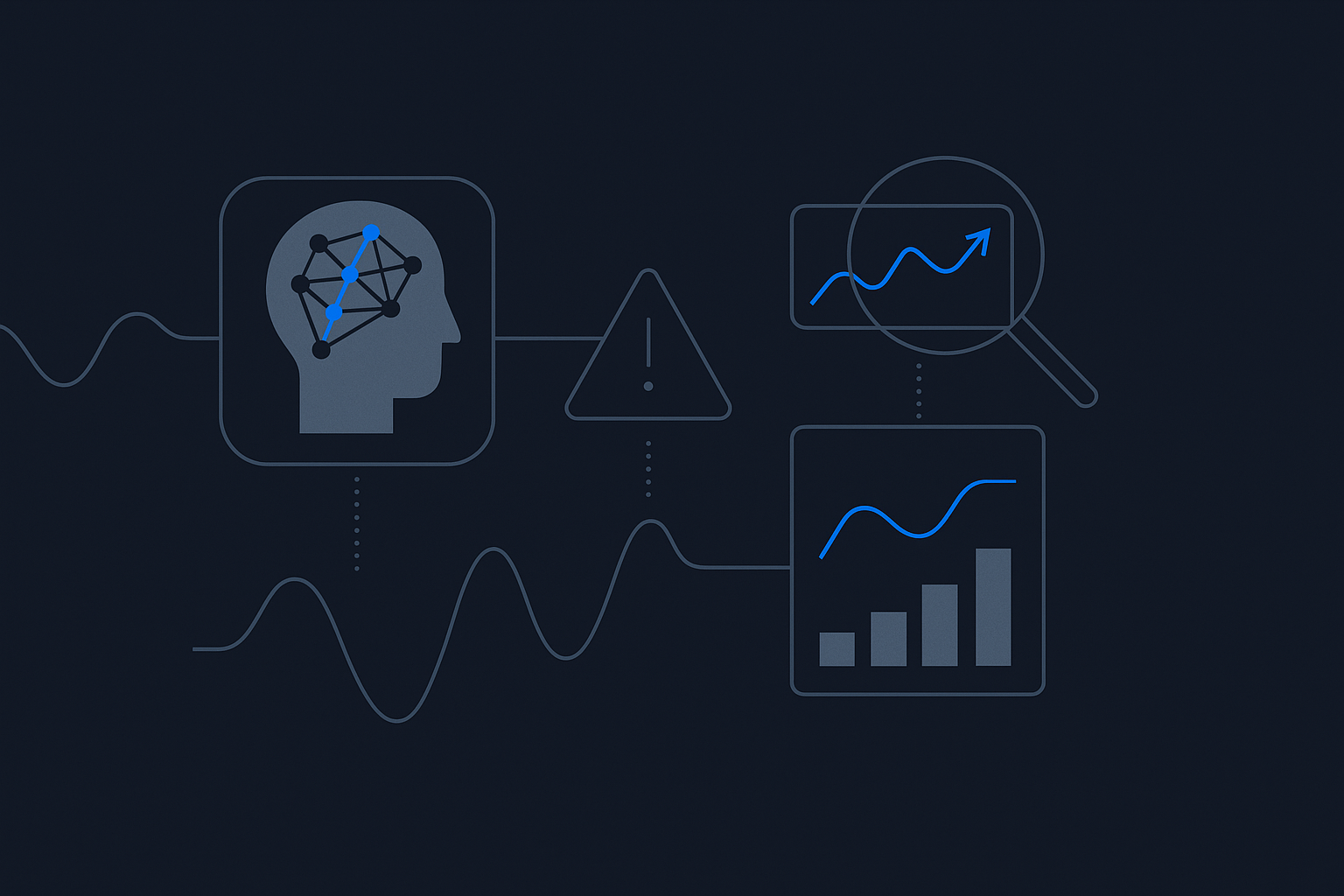
The recurring theme of this course is that regulated AI has no finish line, and nowhere is that more concrete than in monitoring. A model deployed today is a snapshot of a world that immediately begins to change. Customers behave differently, economic conditions shift, fraud patterns evolve, populations move — and the model, frozen at the moment of training, slowly falls out of step with the reality it is supposed to represent. None of this requires a single line of code to change. The system degrades silently, and unless you are watching, the first sign of trouble is the harm itself. Monitoring is the discipline of watching, so that degradation is caught early and acted on before it becomes a failure you have to explain.
Why models degrade: drift
The central phenomenon is drift — the divergence between the world the model was trained on and the world it now operates in. Drift comes in related forms worth distinguishing, because they call for different responses.
Data drift
The inputs the model receives change distribution over time. The population shifts, new patterns appear, the mix of cases changes. The model is still seeing the features it expects, but their statistics no longer match training, and its predictions become less reliable for the parts of the input space that have moved.
Concept drift
More insidiously, the relationship the model learned between inputs and outcomes changes. What predicted default, fraud, or risk yesterday may not predict it today, because the underlying dynamics have shifted. Concept drift is harder to detect than data drift, because the inputs may look unchanged while the meaning of the pattern beneath them has moved.
Feedback loops
A subtle and dangerous case arises when the model's own decisions shape the future data it learns from. A model that declines certain applicants never sees how they would have performed, so its future training data is shaped by its past decisions, potentially entrenching errors and biases in a self-reinforcing loop. Detecting and breaking such loops requires deliberate design, because ordinary monitoring of "performance" can look fine while the loop quietly narrows the world the model can see.
Your model does not have to change to become wrong. The world only has to move, and it always does.
What to monitor
Effective monitoring watches several layers, because problems show up in different places.
- Inputs. Track the distribution of incoming data and compare it to training, so data drift is detected as it emerges rather than after it has degraded decisions. Watching inputs gives the earliest warning, because input drift often precedes performance loss.
- Outputs. Track the distribution of the model's predictions. A shift in the rate of approvals, flags, or scores can signal that something has changed even before you can measure accuracy.
- Performance. Where you can observe actual outcomes, track real performance against expectations. This is the most direct signal but often the most delayed, because outcomes (did the loan default? was the claim fraudulent?) may take months to materialise.
- Fairness. Continue the disparate-impact testing of Part 9 in production, because a model fair at launch can drift into unfairness. Fairness is not a one-time check.
- Human overrides. As Part 10 noted, a rising override rate is often the earliest human signal that a model is degrading — the people closest to the decisions sense the model slipping before the metrics confirm it.
- Operational health. The ordinary signals of any production system — latency, errors, availability — which also bear on whether the system is serving decisions correctly.
From signal to action
Monitoring that no one acts on is merely expensive observation. The value comes from connecting signals to responses, which requires deciding in advance what thresholds matter and what happens when they are crossed. A workable monitoring regime defines, for each signal, the level of deviation that triggers attention, the level that triggers investigation, and the level that triggers intervention — and routes each to someone with the authority and information to act (the informed, empowered owner of Part 4). Without predefined thresholds and a clear escalation path, monitoring degenerates into dashboards everyone glances at and no one owns, which is no monitoring at all.
Responses should be proportionate and prepared: heightened scrutiny when early signals appear, investigation when drift is confirmed, and — when warranted — retraining, rollback to a known-good version, tightening of human oversight, or, in serious cases, suspending the system. Knowing these responses in advance turns a drift detection into a calm, practised reaction rather than an improvised scramble.
Monitoring meets validation
Monitoring and validation are two halves of the same continuous discipline. Monitoring detects that something has changed; revalidation determines whether the system is still fit in light of the change. The two are linked by triggers: significant drift, performance degradation, fairness deterioration, or a material change in use should each trigger a revalidation, in which the independent validator of Part 12 reassesses whether the system remains fit for purpose. Alongside these triggered revalidations sit scheduled ones, performed periodically regardless of signals, on a cadence set by the system's risk and volatility. Together they realise the principle from Part 12 that a model is validated "as of a date, under conditions that expire" — monitoring tells you when the conditions have shifted, and revalidation re-establishes whether you can still rely on the system.
Monitoring as evidence
As with every control in this course, monitoring must be evidenced. The monitoring regime, its thresholds, its alerts, and the actions taken in response all belong in the audit trail (Part 11). When a regulator asks how you ensure a high-risk system remains safe over time — and they will — the answer is your monitoring and revalidation record: here is what we watch, here are the thresholds, here is what fired, and here is what we did about it. A firm that can produce this demonstrates that its governance is alive, not frozen at launch. A firm that monitors nothing, or monitors without acting, has effectively deployed a high-risk system and looked away — which is precisely the posture regulators most distrust.
The cost of not watching
It is worth being blunt about the alternative. A high-stakes model left unmonitored does not announce its decline; it degrades quietly, making steadily worse decisions about real people, until the accumulated harm surfaces as a spike in complaints, a regulatory inquiry, or a headline. By then the damage is done and irreversible for the people affected, and the firm faces the worst possible position: harm that occurred over a long period, that it could have detected and did not, because it treated launch as the end of its responsibility. Monitoring is the comparatively cheap insurance against this expensive failure — and, as the next part on incident response makes clear, even the best monitoring sometimes catches problems only after they have begun to bite, which is why you also need a disciplined way to respond when something does go wrong.
The silence of a degrading model
The reason monitoring is non-negotiable is that a degrading model does not announce itself. Conventional software fails loudly — it crashes, throws errors, returns nothing. A model degrades silently: it keeps running, keeps returning confident outputs, keeps looking healthy, while the decisions it makes grow steadily worse as the world drifts away from the data it learned. There is no exception in the logs, no alert from the infrastructure, nothing to catch the eye of an engineer. The first visible sign, absent monitoring, is the accumulated harm itself — a spike in complaints, a regulator's inquiry, a pattern of bad outcomes that someone finally connects to the model. By then the damage has been done, over a long period, to real people, and it is irreversible for them. Monitoring exists to break this silence: to detect the degradation while it is still a statistical signal rather than a pile of harms, so it can be acted on before anyone is hurt. A high-stakes model deployed without monitoring is not a system being trusted; it is a system being ignored.
A model never tells you it has gone wrong. It just keeps making confident decisions while quietly drifting away from the truth. Monitoring is how you hear what the model will not say.
The feedback loop that narrows the world
Among the forms of drift, feedback loops deserve special wariness, because they are both dangerous and easy to miss. A feedback loop arises when a model's own decisions shape the data it later learns from. A lending model that declines certain applicants never observes how those applicants would have performed, so the outcomes it can learn from are confined to those it approved — and a future model trained on that data inherits and entrenches the original model's choices, including its errors and biases, in a self-reinforcing spiral. The world the model can see narrows to the world its past decisions allowed. What makes this so hazardous is that ordinary performance monitoring can look perfectly healthy throughout: the model performs well on the cases it sees, precisely because it has stopped seeing the cases that would reveal its blind spots. Detecting and breaking feedback loops requires deliberate design — for instance, retaining some exploration outside the model's decisions, or monitoring for the tell-tale narrowing of the data distribution over time — because the loop will not show up in the metrics that assume the data is an honest sample of the world.
From dashboard to action
Monitoring that no one acts on is merely expensive observation, and the most common monitoring failure is not the absence of dashboards but the absence of consequences attached to them. Signals become useful only when each is tied, in advance, to a threshold and a response and an owner. For every signal — input drift, output shift, performance, fairness, override rates — a working regime defines the level of deviation that triggers attention, the level that triggers investigation, and the level that triggers intervention, and routes each to a named person with the authority and information to act. Without predefined thresholds, monitoring degenerates into charts everyone glances at and no one is accountable for, where a slow drift is always "probably fine" until it is suddenly a crisis. And the responses must be prepared, not improvised: heightened scrutiny when early signals appear, investigation when drift is confirmed, and — when warranted — retraining, rollback to a known-good version, tightening of human oversight, or suspension of the system. Deciding these responses in advance turns a drift detection into a calm, practised reaction rather than a scramble, and turns monitoring from a comforting display into a genuine control.
Monitoring and validation as one discipline
Monitoring and validation are best understood not as separate activities but as two halves of a single continuous discipline of keeping a system defensible over its life. Monitoring detects that something has changed; revalidation determines whether the system is still fit in light of the change. They are bound by triggers: significant drift, performance degradation, fairness deterioration, or a material change in use each prompts the independent validator to reassess whether the system remains fit for purpose. Alongside these triggered revalidations run scheduled ones, performed periodically regardless of signals, on a cadence matched to the system's risk and volatility. The two forms cover each other's gaps — scheduled revalidation catches slow erosion that no single trigger flags, while triggered revalidation responds to discrete events between scheduled reviews. Together they make real the principle that a model is validated as of a date under conditions that expire: monitoring watches for the conditions to shift, and revalidation re-establishes whether the system can still be relied upon. A regulator who asks how you keep a high-risk system safe over time is asking to see exactly this loop — what you watch, what thresholds you set, what fired, and what you did — and a firm that can show it demonstrates that its governance is alive rather than frozen at launch.
In the next part: incident response and model failure — how to prepare for, contain, and learn from the failures that monitoring will eventually surface.