
Deploying the Model in Production and Keeping It Accurate Over Time
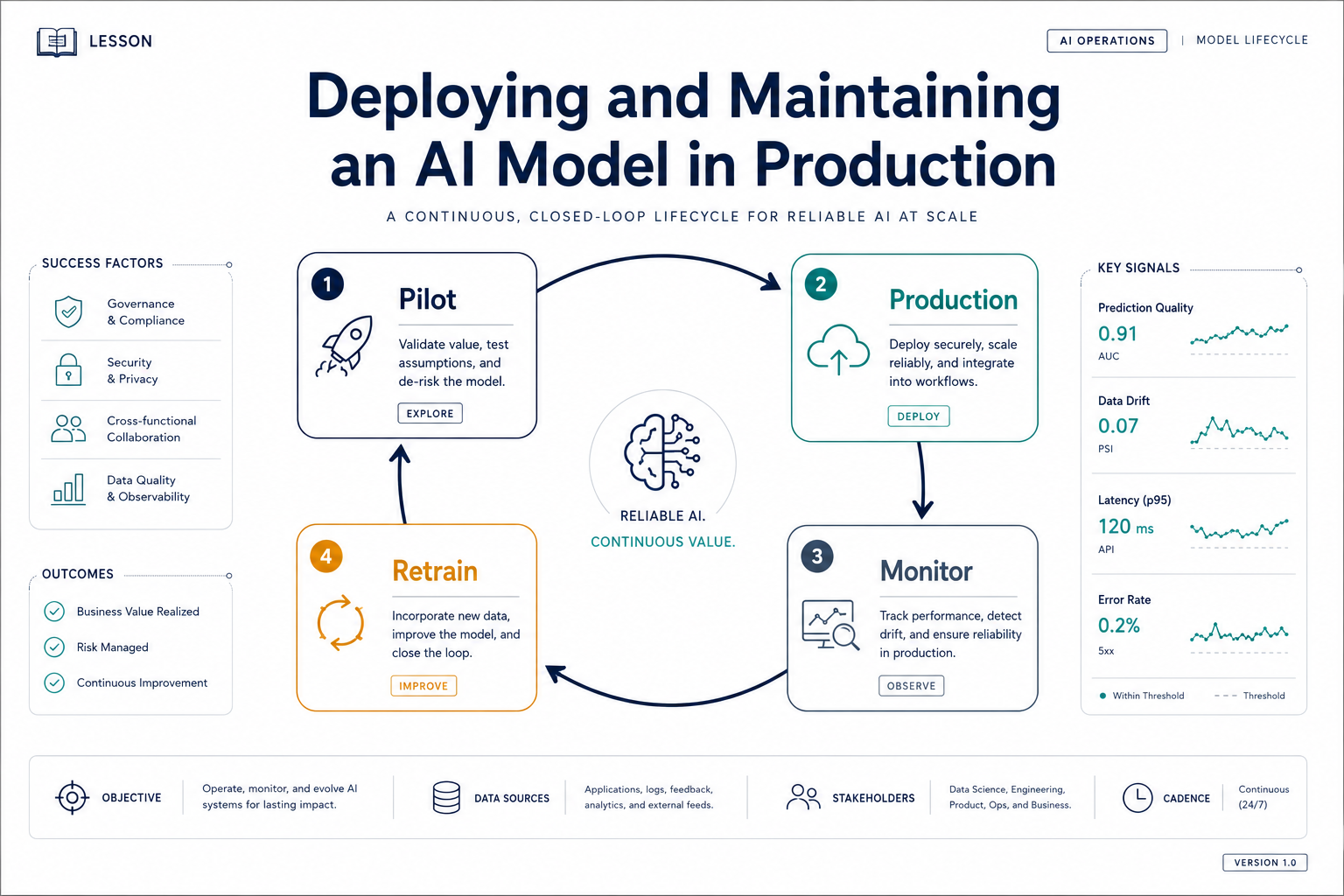
Part 6 of 6 — AI for Operations & Supply Chain
The model met its success criteria. Eighty-seven percent accuracy, an 82% catch rate, false alarms low enough that the planner does not tune it out. By every measure from lesson 5, it works.
None of that means it is done. A model that performs well in testing and a model that performs well in production for the next two years are not the same achievement. Testing happens once, on a fixed dataset, under controlled conditions. Production happens every day, on data that keeps changing, in a workplace where people can ignore the output, stop logging outcomes, or quietly lose trust in it after one bad flag.
This lesson covers the part of the project that most teams underinvest in: rolling the model out without breaking anything, keeping it honest once it is live, and knowing when to rebuild it.
Do not flip the switch all at once
The biggest deployment mistake is treating "the model works" as the finish line and pushing it straight into every planner's daily workflow the next Monday. Even a genuinely good model can cause real damage if it is wrong in a way nobody expected, and the first time that happens in front of the whole team is the worst possible way to build trust in it.
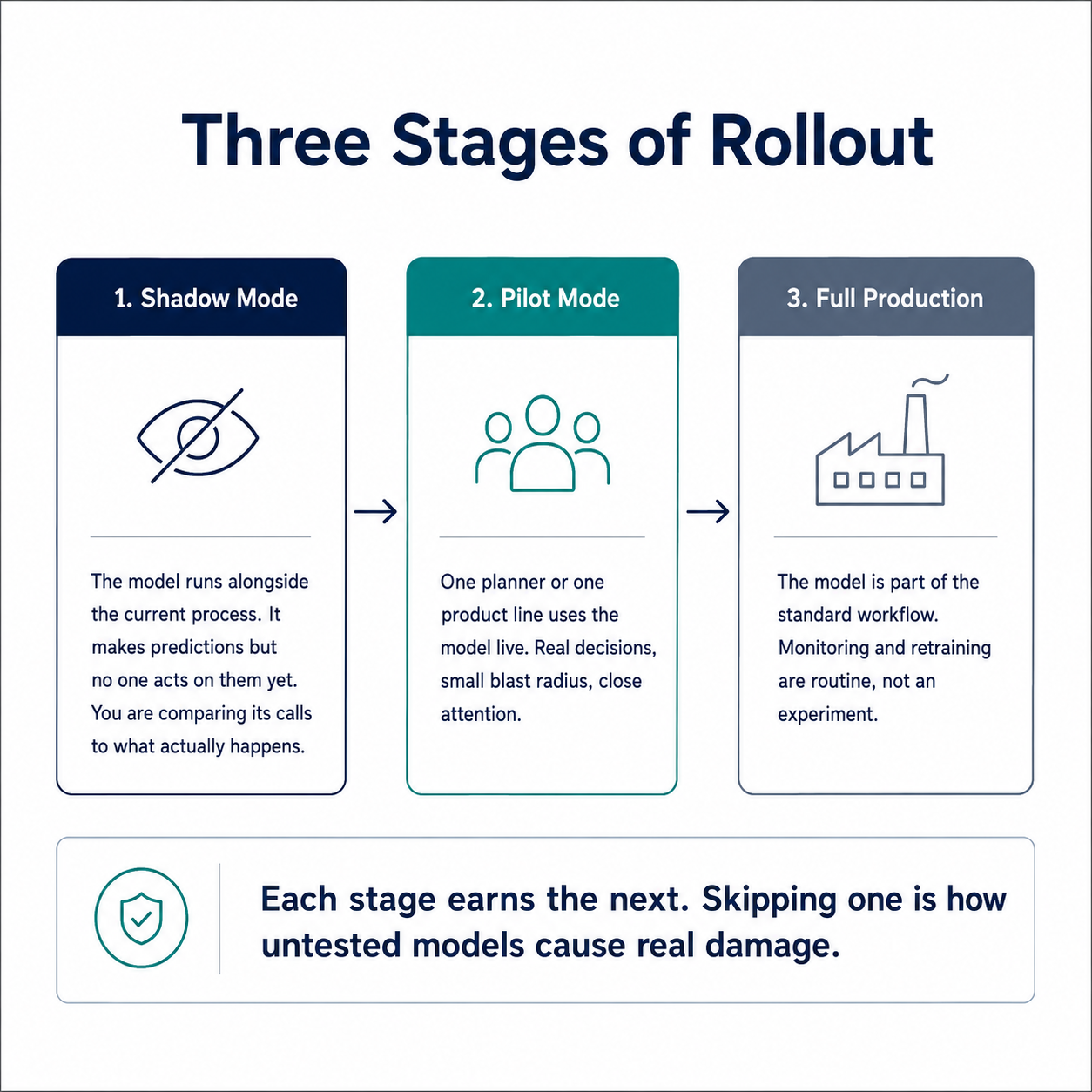
Shadow mode. The model runs, but its output goes nowhere except a log. No planner sees the flags. No decision changes. For two to four weeks, you are simply comparing what the model would have said to what actually happened, on live data it has never touched before. This is where you find the gap between test-set accuracy and real-world accuracy, and there is almost always a gap, because production data has quirks your historical dataset did not.
Pilot mode. One planner, one product line, or one warehouse starts acting on the model's flags for real. The blast radius is small on purpose. If the model is wrong about a $400 order, that is a manageable mistake. If it is wrong about your top account's entire quarter in week one, that is a much harder conversation. Run the pilot long enough to accumulate a meaningful sample, usually six to eight weeks, and check the results against the same three metrics from lesson 5: accuracy, catch rate, false alarm rate.
Full production. The pilot held up, the planner trusts the flags, and the model becomes part of the standard workflow rather than an experiment someone is keeping an eye on. This is also the point where monitoring and retraining need to become routine, not something you remember to do when someone complains.
Each stage exists to catch a different kind of failure before it gets expensive. Skipping shadow mode means you find out about data quirks from an angry planner instead of a quiet log file. Skipping the pilot means your first real-world test happens at full scale.
Deployment is not the finish line, the feedback loop is
Here is the fact that catches most teams off guard: a model that is never updated is a model that is aging from the day it launches. It was trained on data through last quarter. The moment it goes live, every day that passes is a day the world has moved slightly further from what it learned. The only thing that keeps a model useful over time is a working feedback loop that feeds it what actually happened.
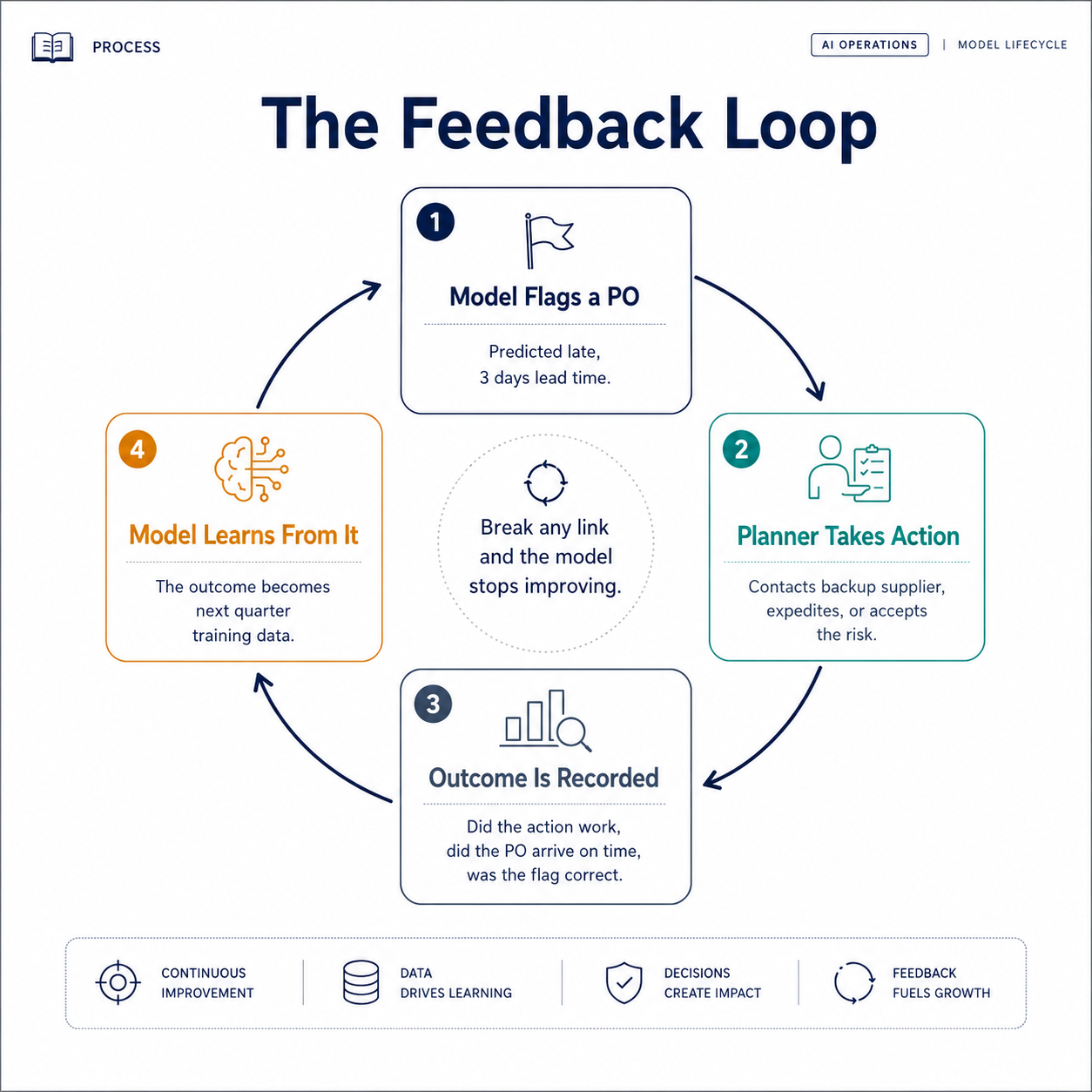
Walk through what has to happen, every time, for the loop to stay closed. The model flags PO-90142 as likely to be five days late. The planner sees the flag and decides what to do: call the supplier, line up a backup, or accept the risk and move on. Then, and this is the step almost every team drops, someone records what actually happened. Did the PO arrive late? Did the planner's action work? Was the flag right in the first place?
That recorded outcome is not paperwork. It is the exact same raw material lesson 2 described: an example with a known answer. Without it, the next retrain has nothing new to learn from, and you are stuck with a model that only knows the world as it existed the day you built it.
This is why the four roles from lesson 4 do not disband after launch. The user keeps logging outcomes. The builder keeps retraining. The sponsor keeps the whole thing prioritized. A project plan that ends at "deploy" has quietly planned for the model to go stale.
Every model decays. The question is whether you notice.
Models do not fail the way software usually fails. There is no error message, no crash, no ticket in the queue. A model in decline just gets a little less right, week after week, in a way that is easy to miss if nobody is watching for it.
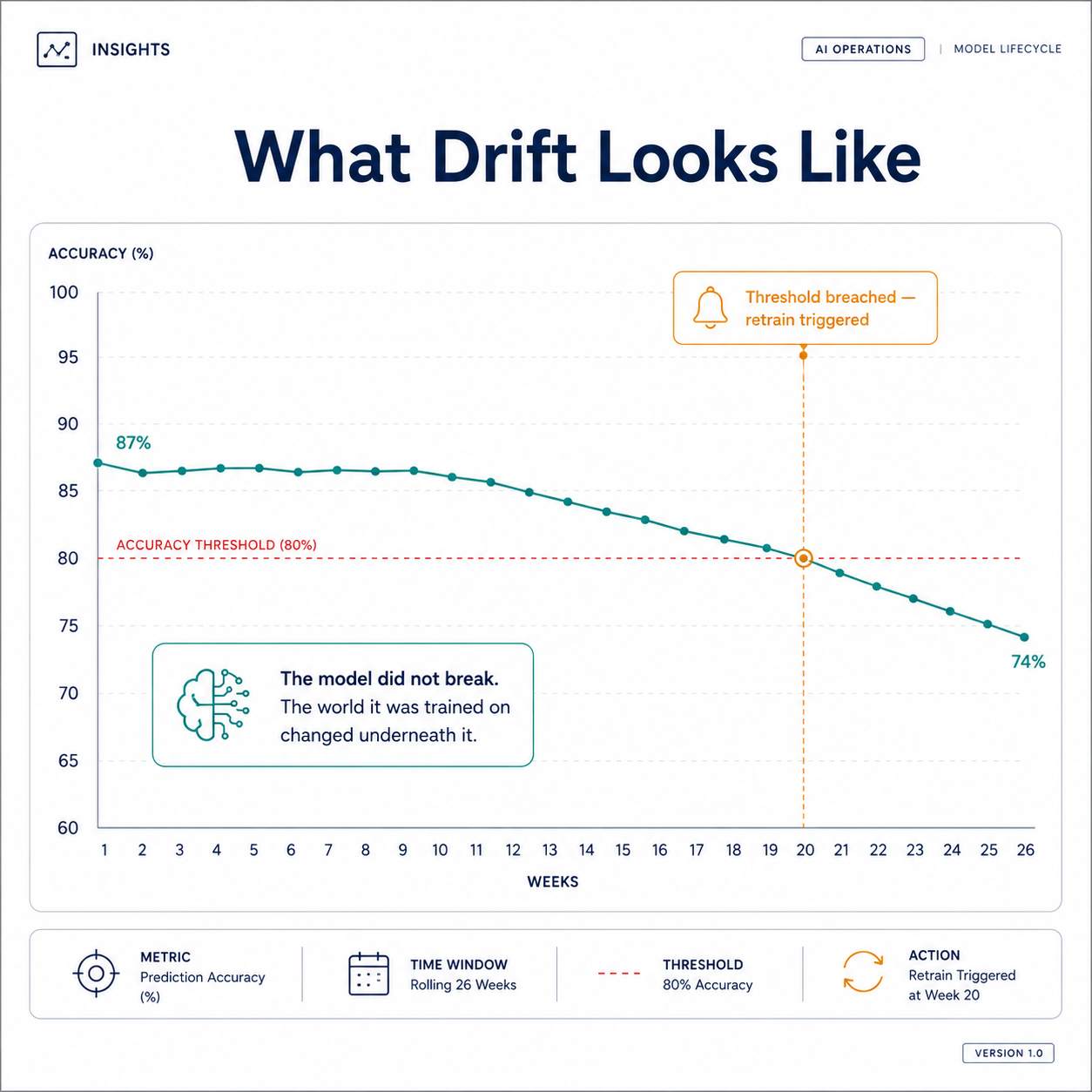
This is called drift, and it happens for reasons that have nothing to do with the model being poorly built. Your supplier base changes. A major customer's ordering pattern shifts. A commodity that used to be stable becomes volatile. The process the model learned from October's data is not quite the process running in June. None of that is a bug. It is the ordinary passage of time, and every model trained on historical data is exposed to it.
The danger is not that drift happens. The danger is that it happens slowly enough to go unnoticed until the model has quietly become a liability. Accuracy that slides from 87% to 81% to 76% over five months does not trip any alarm on its own. It just makes the planner trust the flags a little less each week, usually without anyone naming why.
Building a monitoring habit
You do not need a dedicated analytics team to catch drift. You need four numbers, checked on a schedule, by someone whose job it is to check them.
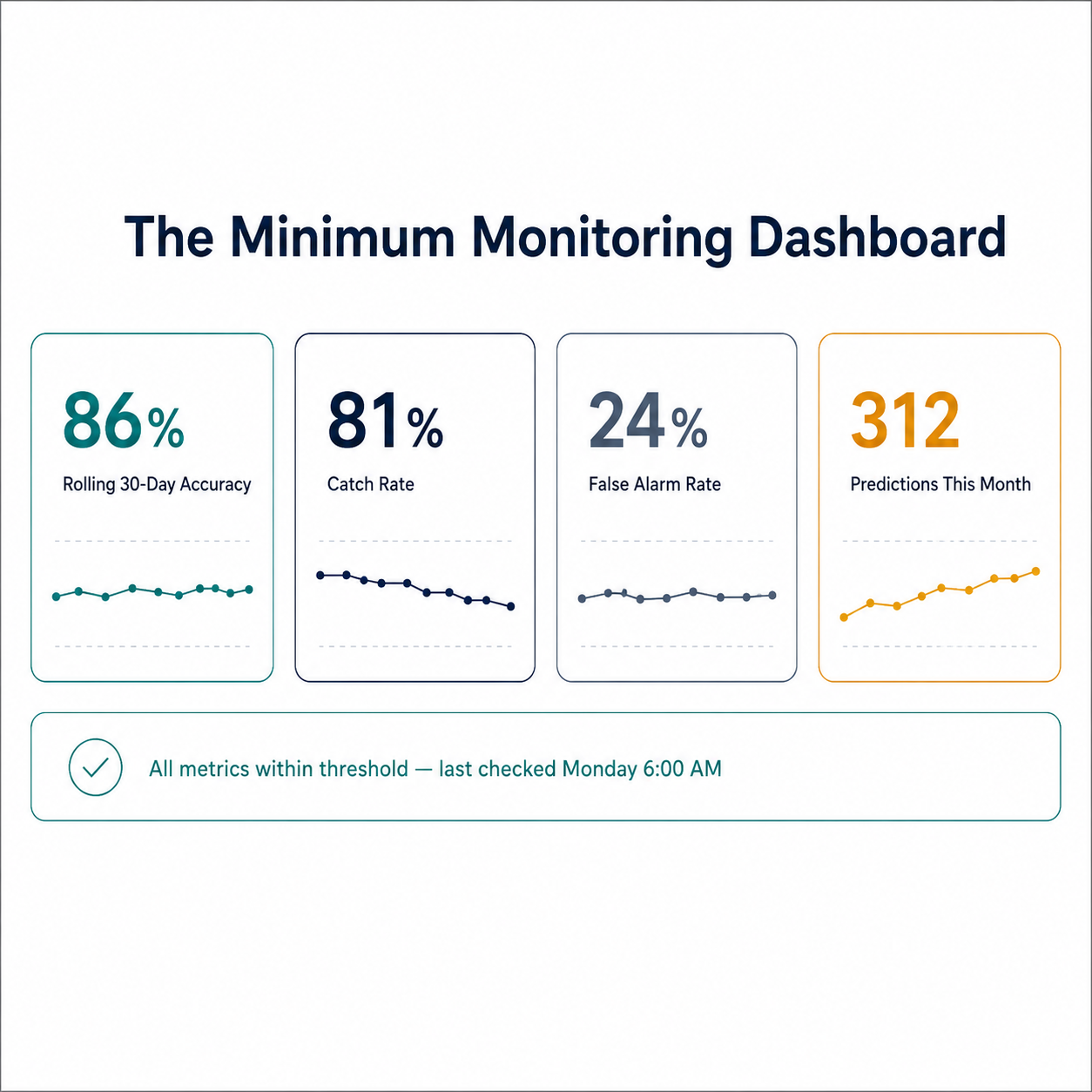
Rolling accuracy. Recalculate the same accuracy measure from lesson 5, but over the trailing 30 or 60 days of live predictions instead of the original test set. This is the single most important number, and it should be checked at least monthly.
Catch rate and false alarm rate. The same two numbers from lesson 5, tracked over time. A model can hold steady on overall accuracy while quietly getting worse at catching the risks that matter most, so do not watch accuracy alone.
Prediction volume. How many predictions the model is actually making. A sudden drop can mean an upstream data feed broke, which is a much more common failure than the model itself getting worse.
Set the thresholds from lesson 4's success criteria as your alert lines. When a metric crosses the line, that is not a crisis, it is the system doing exactly what it is supposed to do: telling you it is time to look closer.
When and how to retrain
Retraining is simply repeating the process from lesson 5, using more recent data. The only real question is timing.
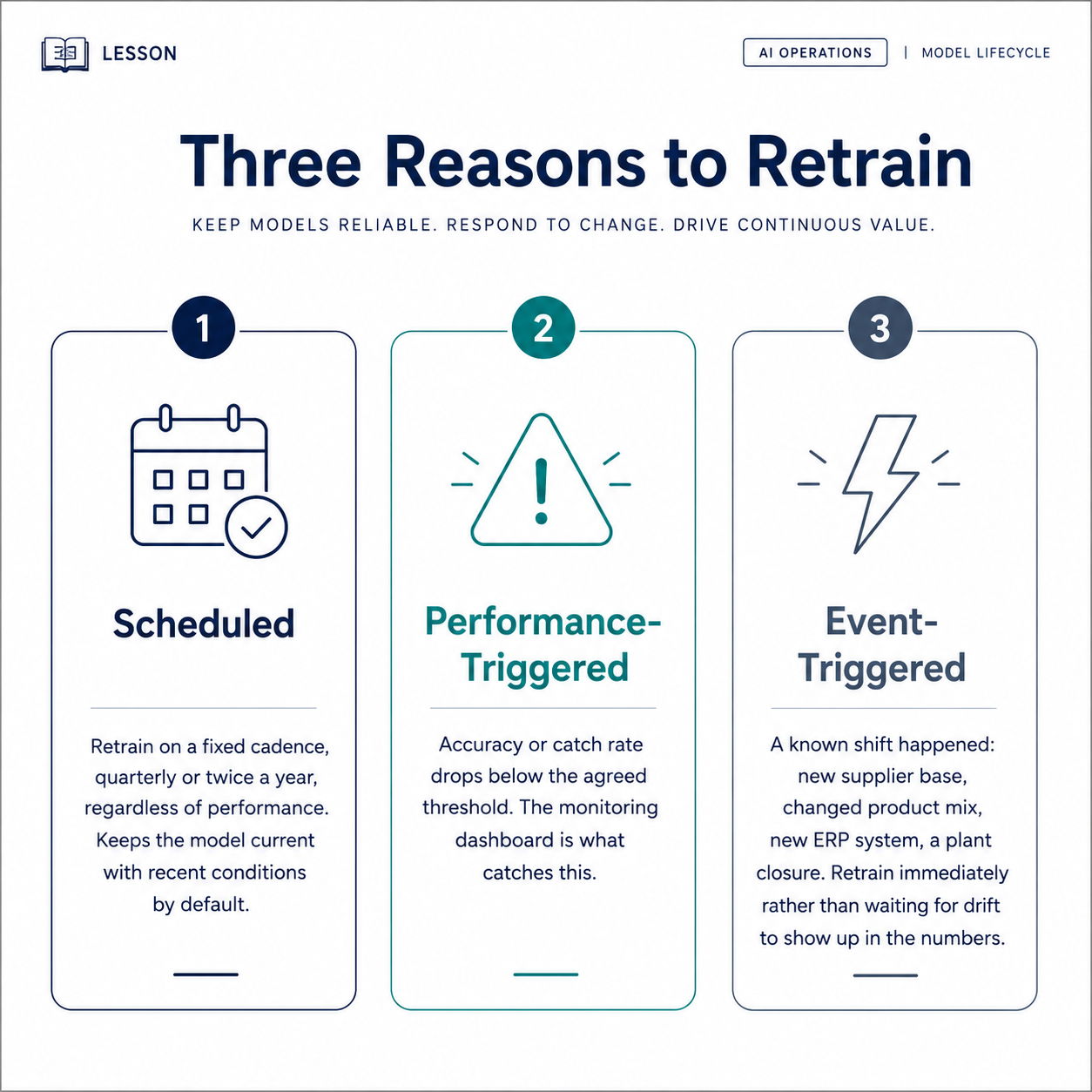
Scheduled retraining. Pick a cadence, quarterly is typical for most operations use cases, and retrain on that schedule regardless of what the dashboard says. This keeps the model current by default and catches slow drift before it crosses your alert threshold.
Performance-triggered retraining. The monitoring dashboard crosses a threshold, and you retrain in response. This is the safety net for drift that moves faster than your scheduled cadence anticipated.
Event-triggered retraining. Something changed that you already know invalidates part of what the model learned: a new ERP system, a major supplier change, a product line discontinued. Do not wait for the dashboard to catch up to news you already have. Retrain as soon as enough post-change data exists to be useful.
Each retrain follows the same discipline as the first build: prepare the updated data, train, hold out a fresh test set, evaluate against the same success criteria. A retrain that skips evaluation is just hoping the new version is better.
Five ways production models fail quietly
Most model failures in operations are not dramatic. They are slow leaks that nobody notices until the model has stopped earning its keep.
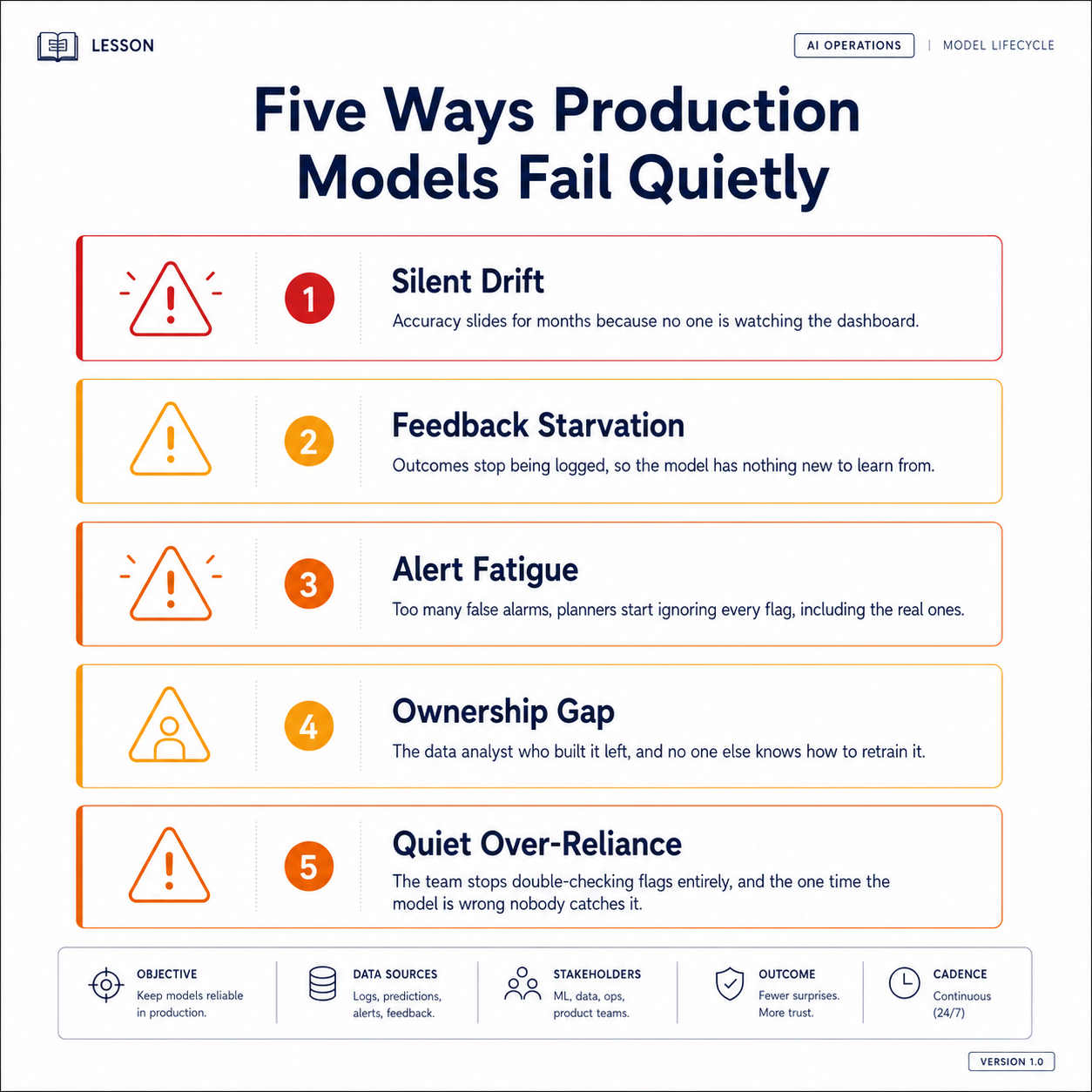
Silent drift. Covered above. The fix is the monitoring habit: someone checks the dashboard, on a schedule, whether or not anything seems wrong.
Feedback starvation. The logging step in the feedback loop quietly stops happening. Maybe the planner who set it up left. Maybe it was never built into the actual workflow, just a good intention. Without outcomes, the next retrain has nothing new to learn from, and the model is frozen at the day it was last trained.
Alert fatigue. Too many false alarms and the planner starts treating every flag as noise, including the real ones. This is why lesson 4's actionability criterion matters as much after launch as before it: a flag with no available response trains people to ignore flags.
The ownership gap. The analyst who built the model moves to a different team, and nobody left knows how to retrain it, read the dashboard, or explain why a specific prediction came out the way it did. The model keeps running on autopilot until it is badly wrong about something important.
Quiet over-reliance. The opposite failure of distrust: the team stops sanity-checking flags at all, treats the model as infallible, and the one time it is wrong, nobody catches it before it costs something. A model handles patterns. A person still handles judgment, exactly as lesson 1 said on day one of this course.
Who owns this after launch
Every one of the failure modes above traces back to the same root cause: nobody was clearly responsible for the specific thing that broke.
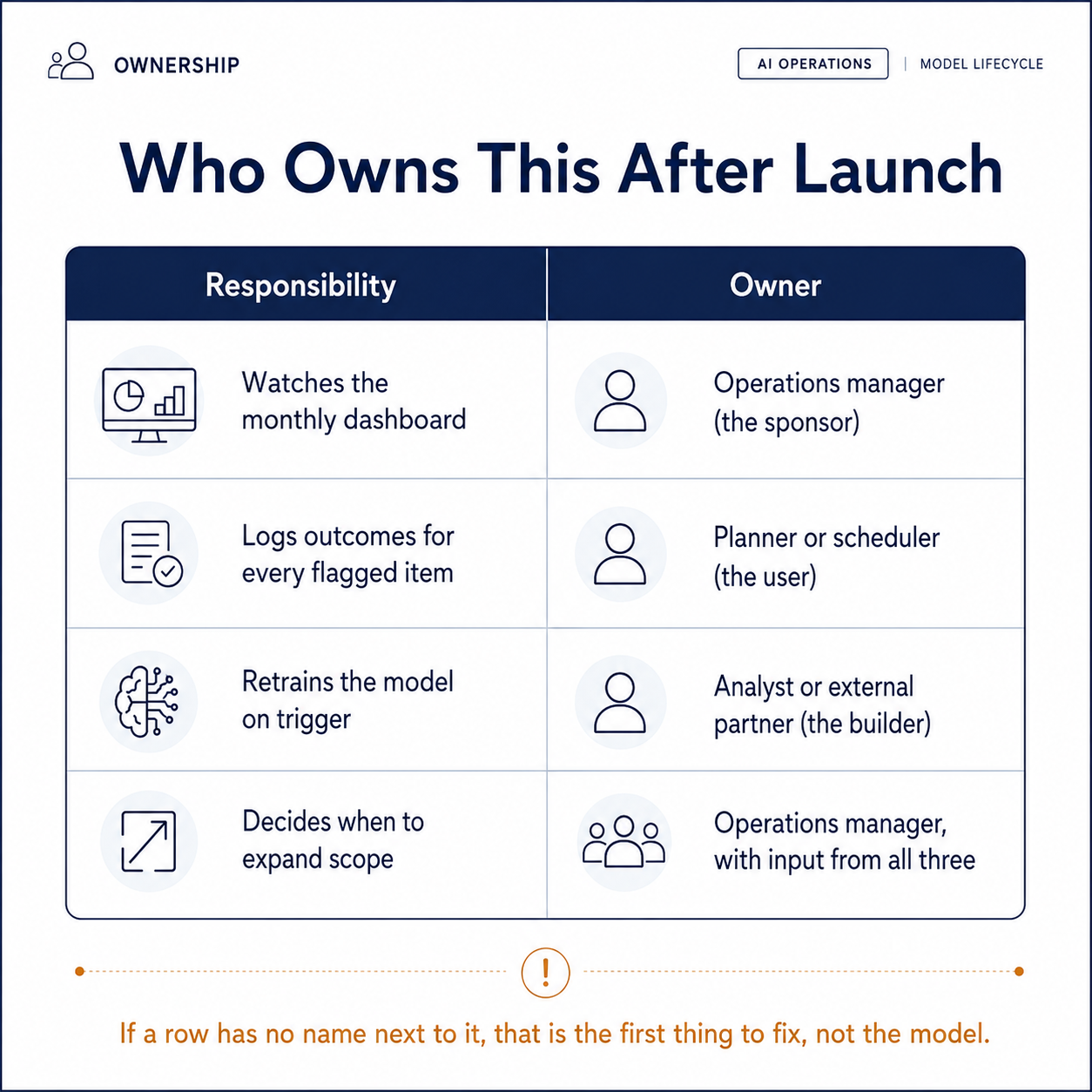
Before you consider the project finished, write down who checks the dashboard, who logs outcomes, who retrains on trigger, and who decides whether to expand scope. Put a name against each line, not a department. "Operations will handle it" is how ownership gaps happen. A specific person, with the time budgeted for it, is how they do not.
From one project to an AI-enabled operation
Six lessons ago, this course opened with a distinction: rules-based automation executes what a human already knows, and AI finds patterns in what a human cannot fully hold in their head. Everything since has been about turning that distinction into one working project, end to end: choosing a problem the data could actually support, building a model, testing it honestly, and now keeping it alive in production.
That is the template. The next project follows the same shape. Pick a narrow, repeated, well-recorded problem. Fill in the problem statement. Audit the data honestly. Set success criteria before you build anything. Prepare the data, train, evaluate against a held-out test set. Roll out in stages. Build the feedback loop before you need it, not after. Watch the dashboard. Retrain on a schedule.
Nothing about that sequence gets easier to skip as you gain confidence. If anything, the second project is riskier than the first, because it is tempting to move faster once you know the shape of the process. The teams that get real, compounding value from AI in operations are not the ones with the fanciest models. They are the ones that treat every step in this course as a habit, not a one-time event.
Key takeaways
- Roll out in three stages: shadow mode to compare predictions against reality with no one acting on them, pilot mode with real decisions at small scale, then full production. Each stage catches a different failure before it gets expensive.
- The feedback loop, flag, action, recorded outcome, retrain, is what keeps a model from freezing at the day it launched. If outcomes stop being logged, the model stops learning.
- Every model drifts as the world it was trained on changes. Drift rarely announces itself. A monitoring habit, checking accuracy, catch rate, false alarm rate, and volume on a schedule, is what catches it.
- Retrain on three kinds of triggers: a fixed schedule, a performance threshold crossed on the dashboard, or a known event that changed the underlying process. Evaluate every retrain the same way you evaluated the first model.
- Most production failures are quiet: silent drift, feedback starvation, alert fatigue, an ownership gap, or the team over-trusting the model and no longer sanity-checking it. Watching for these by name is most of the prevention.
- Assign a specific person, not a department, to each post-launch responsibility. An unowned model degrades exactly like an unmaintained machine.
- The process in this course is a repeatable template, not a one-time project. Apply it again to the next problem, and treat every step, especially monitoring and retraining, as an ongoing habit rather than a launch-day checklist.